Showing posts with label Oklahoma State. Show all posts

Sunday, August 15, 2010

College Football Vegas Odds: Take Georgia, Leave BYU, and Other Sure-Fire Winners In Week One

The college football odds-makers released a few of lines over the weekend and, I have to admit, I found a few of them very intriguing—particularly as an admitted follower and supporter of the Georgia Bulldogs. That said, I perused a few of the prognostications by both Vegas and those who offer some offshore action and decided to pick a few games that favor you, the bettor, if you are the gambling kind.

In the interest of full-disclosure, I will say that I do not proclaim myself to be an expert in the game of betting on college football. In fact, my knowledge is probably about as extensive as any novice, but I do know a little something about college football and I feel pretty confident in saying that I've won more than I've lose where picking a game is concerned.

That said, dispute me if you's like, but I'm going all-in on these five teams during the week one of the college football season:

1. UL-Lafayette at Georgia (Georgia -28)

The Georgia Bulldogs are not a team that one can usually bet on with a lot of confidence. In 2009, they were 5-7 against the spread (ATS)—often losing when favored. However, they return 16 starters, 10 of which are on defense and, although mixed results will be expected of the new-look defensive unit, there is still enough talent on that side of the ball to feel confident that they'll be fighting hard in week one.

UL-Lafayette will come in with an offense that will be mediocre (at best)—returning only five starters. Furthermore, the Ragin' Cajuns didn't prove to be stout in their games against upper-tier opposition last season; losing by a total margin of 83-points to both LSU and Nebraska, for an average margin of defeat of 41.5 points.

The last time Georgia faced a Sun Belt opponent was 2007 when they won a 44-34 squeaker over Troy in Athens. Don't expect it to be anywhere near that close against UL-Lafayette. Look for Georgia to take control early and win their opener by better than four touchdowns.

2. Washington State at Oklahoma State (Oklahoma State -14)

This game is dangerous. It's a risky proposition to be too bold in choosing either team to do anything but disappoint you this season. Oklahoma State lost the hear of it's offense, defense, and special teams in Zac Robinson, Perrish Cox, and Keith Toston. So, it's a rebuilding year in Stillwater—no matter what Mike Gundy tries to tell you.

However, a rebuilding Oklahoma State is still 10 times better than a Washington State Cougar team that hasn't had a winning season since 2004 and has won increasingly less games since 2006—culminating in a one-loss stinker in 2009.

The Cowboys will be playing in the friendly confines of Boone-Pickens stadium and still have Kendall Hunter to run the ball for them on offense. They won't have to fight too hard for this one as the Cougars return a unit that not only was dead last in total defense, but ranked near the bottom of the FBS in offense as well.

Easy (Boone) Pickens...if you ask me. Take the Cowboys.

3. Washington at BYU (BYU -3)

I'm confused by this one, but I'm going to presume that the Cougars are getting a lot of love for simply playing at home—right?

The Huskies are the sexy Pac-10 pic for this season and they are led by probable Heisman candidate, Jake Locker. Many are expecting Steve Sarkisian to lead his squad to a bowl berth this season and, possibly, challenge the Pac-10 for a spot in the championship. High hopes abound for this Seattle bunch.

On the other hand, BYU lost most of their offense–most devastatingly Harvey Unga (RB) and Max Hall (QB). Even more, that front seven that made Oklahoma look like a high school football team in their 2009 opener has only one returning starter to speak of...uh-oh.

BYU might be formidable in Provo, but they are also the same team that managed to lose to an inconsistent Florida State squad in week three, so they aren't invincible by any stretch.

Call me crazy, but I like the Huskies in this one.

4. LSU at North Carolina (North Carolina +1.5) "UPSET SPECIAL"

I expect this game to be ugly, close, and down-to-the-wire. It's not that I think North Carolina is amazing, but rather my thinking that the Tar Heel defense is phenomenal. I believe it's good enough to make life for LSU (who lost every significant ball carrier at the end of 2009) very difficult on offense.

Too bad North Carolina's offense isn't nearly as impressive.

Even though the Tar Heels will bring back eight offensive starters—including quarterback T.J. Yates—they are still not going to shock the world by putting up major point totals. So, if LSU plays even a little bit competent on defense, they will have no problem shutting UNC down.

That said, this game will be about field position and special teams. I give the slight edge to North Carolina here as LSU lost its two leading return men in both Trindon Holliday and Chad Jones while the Tarheels, who were ranked near the top of the FBS in special teams defense last season, return the bulk of their special teams unit.

I'm calling for an upset by the Tar Heels in week one...assuming the NCAA doesn't dismantle the defense in short-measure. If that happens, well, it's going to be LSU in a walk.

5. Connecticut at Michigan (Michigan -3.0)

While I can understand the desire to bet on a team that stands 5-0 ATS on the road (UConn), this is still a Michigan team that has a ton of talent on offense and a lot of expectations riding on the success of the program, under Rich Rod, this season.
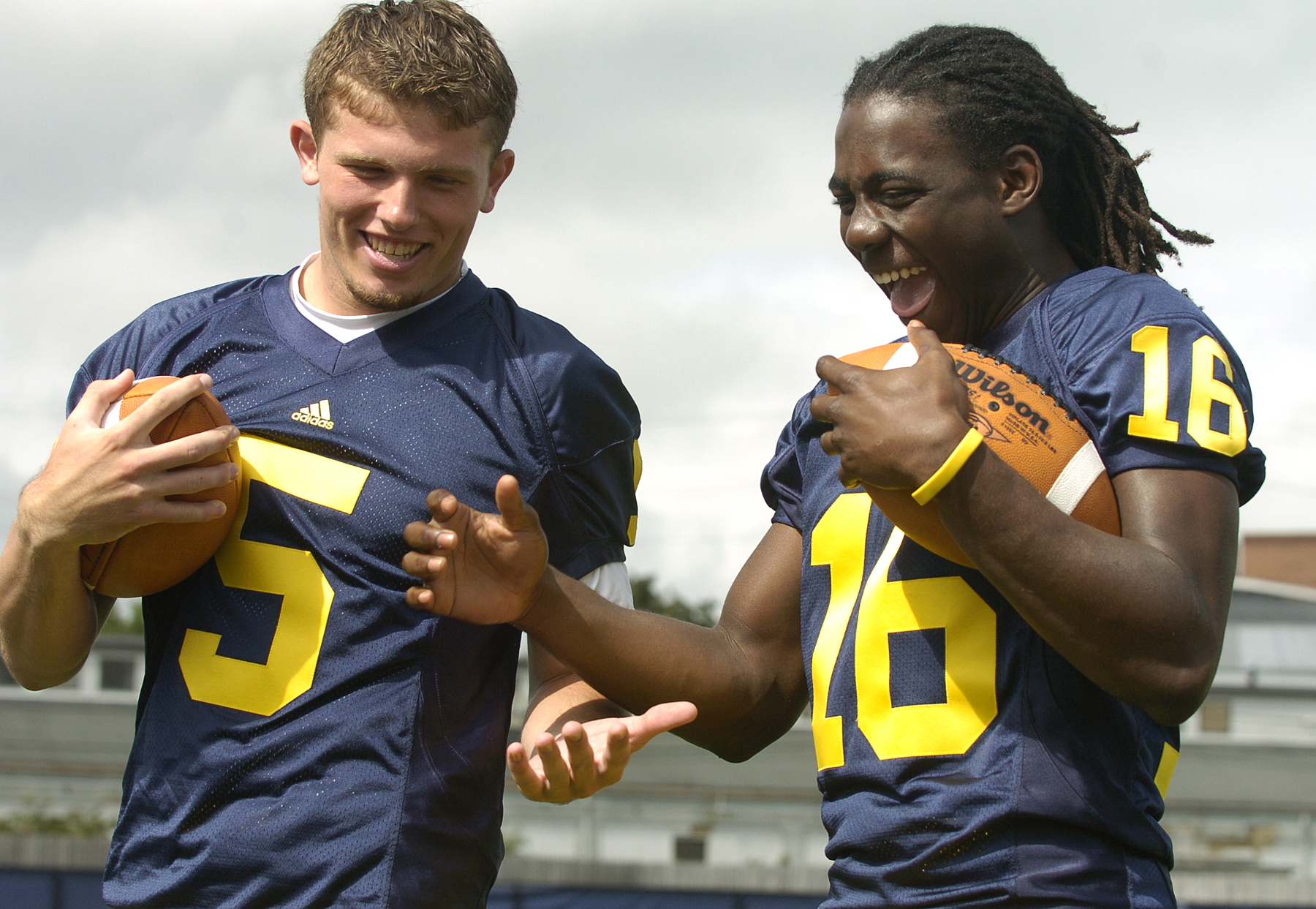
The Huskies are as stout as they come on defense and this game will, no doubt, be a big one for Randy Edsall's bunch this season, but the Huskies sustained some important losses with the departures of not only Andre Dixon (1,093 yards rushing and 14 TD's) and Marcus Easley (48 receptions, 893 yards, and 8 TD's), but in big legged punter, Desi Cullen (42.8) as well.

Even more, there has to be some hesitation as to how much pressure the Husky defense will get up front minus all of their starting linebackers from last season.

No pass rush means a lot more time for Tate Forcier, or Denard Robinson, to pick apart or just plain run circles around that front seven and find their receivers.

The Wolverines may have a lot of questions coming into this season (including whether or not the defense can find a playmaker or two), and Rich Rod could find a pink slip in his box come season's end, but this game will be won by the Wolverines—bringing the UConn ATS streak to an unceremonious end. 
Enhanced by Zemanta

Monday, June 14, 2010

Was Texas Playing 'Chicken' With Dan Beebe All Along?

It was announced this morning that the Texas Longhorns, along with the coat tail riding contingent of Texas Tech, Oklahoma, and Oklahoma State, have decided to accept the Big 12's proposal and stay in the Big 12.

Well, Yippee.

Here's the thing, who doesn't believe that the Longhorns were simply angling for more money and a better shot at getting their own network all along?

Think about it, not only did the money pot get bigger with the exodus of both Colorado and Nebraska, who will be forced to pay $17 million each for their transgressions, but the introduction of the league's intent to allow institutions to pursue their own separate television deal had to be the cherry on top for the Longhorns.

It's no secret that the Longhorns wanted to pursue their own network—a la the YES Network of the New York Yankees—but the Big 12 didn't seem open to that possibility. Dan Beebe skirted the issue time and again while, all the time, Texas was fuming and trying to figure out how to make it happen.

Enter the rumors of a Big Ten or Pac-10 raid of the Big 12 and VOILA!,  there's enough leverage to make the Big 12 and Dan Beebe rethink their stance on how revenue is distributed and how much liberality they will give each team in pursuing their own method of making money.

As an added bonus, both Nebraska and Colorado got scared silly enough to leave altogether. By doing so, the Big 12 North just got a lot less competitive and the money to be gained from any deals struck hence forward just got sweeter.

All of this led me to wonder, if Texas wasn’t just playing a very deceptive game of poker with Dan Beebe from the start?

In truth, most of what any of us heard about the expansion deals came from one of a few random sources, none of whom were in a position to make a decision on the fate of Texas or the Big 12.

Orangebloods.com set off this firestorm early on and by last Friday it was at a full blaze as the sports world essentially jumped on the story and ran.

Seriously, think long and hard about it, what did any of us read about Texas, the Big 12, or the Pac-10's invitation to the Longhorns that did not originate from Orangeblood's, Chip Brown? He was the primary source in just about every breaking news story regarding this situation and he is, of course, the source of the most recent news that Texas will stay in the Big 12 today.

Despite a conflicting report offered by ESPN's Joe Schad, that Texas will bolt for the Pac-10 for the academic prestige over the money, it makes sense that the Big 12 stay configured as a ten team league than go to a 16 team Pac-10 where their financial options would be somewhat restrained.

The Pac-10 is looking to expand their market share in hopes of securing more revenue from television. However, there is no deal in place yet, and any team joining the Pac-10 is doing so on good faith—nothing more.

Further, the Pac-10 is not going to allow Texas to pursue a Longhorn Network if they come over which—in my opinion—is what they truly want to do.

So, why join and split the money 16 ways, deny your program the option of netting an additional$3-5 million in television revenue through developing your own network, and risk disrupting your fanbase, just to join with the Pac-10 for academic reasons?

It just doesn’t make sense.

Now, I admit, all of this conjecture could be proved wrong a day or so from now, but for the moment, it makes more sense for the Big 12 to stay together than break apart.

Enhanced by Zemanta

Monday, June 7, 2010

The Pac-10 Expansion Might Make Dollars, But Does It Really Make Sense?

There has been a lot of talk about expansion lately. It's difficult to Google "college football" or "NCAA" right now and not find yet another article explaining what it is and why it's happening.

Dan Wetzel, of Yahoo sports, writes an extensive article on why the Big 12 is suddenly the goat in this situation. It's a long read, and it's obvious what side of the fence Mr. Wetzel stands on, but it also brought something to mind for me—an SEC fan—who is admittedly a tad confused by the expansion hoopla; why is this good for college football?

The Pac-10 will, allegedly, look to add six teams to their league (Texas, Texas A&M, Oklahoma, Oklahoma State, Texas Tech, and either Baylor or Colorado). In doing so, they will hold the largest market share as far as television revenue goes—making them a very attractive conference to sell to the highest bidder for broadcast rights.

My question is, why would any true fan of college football want a 16-team league? With that many teams, you start to phase out natural rivalries and, in part, you begin to water down the true heart of why many people watch the games—the passion and the pageantry.

With that said, it's obvious that the move, if made, will be totally about money. This isn’t about anything else.

It has nothing to do with enhancing the landscape of college football or bringing about a powerful conference that rivals that of the SEC or the Big Ten—although that's precisely the angle being preached to the common fan—no, it's about dollars and sense.

Whatever conglomeration of conference team members brings in the most dollars, makes the most sense—period.

Which brings about another question, one that I haven't seen answered in any of the blogs, media rhetoric, television interviews, or Twitter talk I’ve imbibed; what if this model fails?

It's an honest question to ask, right? After all, the Pac-10 could be making a huge statement by extending an offer to Texas, but what good is all the revenue Texas would bring, if their counterparts bring little to the table.

Texas is a powerhouse and they always have been. They don’t need the Pac-10 or any other conference’s invitation to continue to hold that title—it’s Texas. However, the other five teams that ride on the coattails of Texas, including Oklahoma, benefit from this partnership more than any other.

Remember, the revenue generated by bowl appearances, BCS wins, and network revenue, is divvied up amongst the conference members—split 16 ways—no matter who is the most responsible for the generation of those funds.

It’s not as if USC, Texas, or Oklahoma will be able to negotiate a 70-30 split—whoever is the best representative for the conference that season, gets the most money. It doesn’t work that way. Teams like Baylor, Washington State, and Texas Tech, stand to make a killing if this expansion model works as planned.

However, if it doesn’t work, then you have a conference that is not unlike that of any other conference at present—all the cream rising to the top.

In my opinion, college football’s popularity has very little do with revenue for the fan. Don’t get me wrong, I understand business models and I know that at the end of the day, you have to be able to compete with the big boys if you want your university to thrive at the national level.

Most university presidents welcome the revenue stream that comes in from football, baseball, tennis, and the like because it gives them the brick and mortar money to continue building their academic programs. I get that, I do.

However, just because you make something bigger and add a pretty bow to it, doesn’t mean that it’s going to be better. Consider the Western Athletic Conference which expanded to 16-teams in 1996.
They had four divisions and were, at one time, considered to be one of the best mid-major conference teams in the land.

It wasn’t long before teams started to see that the arrangement wasn’t as beneficial as first thought. It was hard to cover the expenses of traveling and recruiting on a budget that saw minimal increase from the maximum exposure. It just didn’t make sense.

Of course, the revenue possibilities now are better than they were then but that doesn’t truly make life any better for a team like Washington State, does it?

I don’t know, maybe I a little too old school. I was fine with the way the conferences were aligned already and figured, if anything,  it was time the big boys started kicking the dead weight out—bye, bye Baylor and so long Vanderbilt—in order to add teams that are beginning to make head way in their programs. That, to me, makes the most sense—increase the quality, not the quantity.

Whatever happens in the coming weeks, it’s clear that change is on the horizon. The question remains, for me and some others I am sure, is that change really going to be for the best?

What say you?
Reblog this post [with Zemanta]