The Mountain West Conference (MWC), the oft mentioned but frequently disrespected conference in the FBS, has finally gone off the deep end in it's search for that elusive Automatic Qualifying (AQ) bid from the BCS powers that be—good luck with that if this turns out to be your method of getting there.
According to a recent report, offered via College Football Talk, the MWC and Conference-USA (C-USA) are in the very early stages of a discussion that would pit the MWC Champion against the C-USA Champion in a "play-in" game. The winner would be awarded an AQ bid by the BCS.
Okay, first of all, in what universe would a play-in game versus a C-USA opponent be an attractive package for the BCS?...Seriously?
The recent successes of East Carolina and Houston aside, the overall success of C-USA against current opponents that fall under the AQ umbrella is not impressive—at all. As a matter of fact, the conference as a whole sports a losing percentage against the Big XII (0.383), the ACC (0.377), the SEC (0.334), the Big Ten (0.209), and the Pac-10 (0.322). Shoot, they even have a poor winning percentage against the MWC (0.400).
*scratching my head*
Explain to me again how this idea would be attractive to the BCS?
C-USA might house some great offensive powerhouses in Tulsa, Rice, Houston, and Memphis, but they are far from ready to compete with some of the bigger and better programs of the Big Ten and the SEC—that's laughable.
Admittedly, these discussions are in their infancy and neither side is ready to confidently go forth and present this option to anyone with the power to change things, but the mere fact that this step is being talked about at all puts a glaring spotlight on how badly the MWC is trying to gain legitimacy—they are tired of being the have-nots of college football.
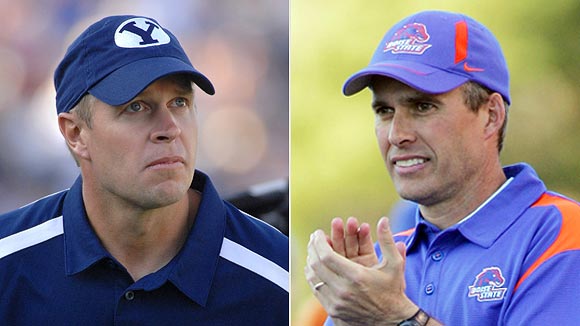
I can't say that I blame them, the Boise State Broncos have gotten more respect as one team in a remarkably unchallenging conference than BYU or TCU have gotten playing in the MWC.
Boise State may have the more attractive record over the last 6-years (bolstered in large part by a 31-1 conference record), including BCS wins over Oklahoma and TCU, but their conference schedule continues to be a joke and their undefeated record at the end of the year seldom houses a quality win over a quality opponent. They play just as many pansies in their OOC match-ups as they do in their own conference—yet they are rewarded for it time and again.
Consider this, the Broncos, under Chris Petersen, are 4-1 against BCS teams that play in a conference with an AQ bid. Those four wins came against Oregon (2-0), Oregon State (1-0), and Oklahoma (1-0). BYU, in that same span of time, is 7-5 against BCS teams with an AQ bid. Their seven wins came against Oregon (1-0), Oregon State (1-0), Oklahoma (1-0), UCLA (2-1), Washington (1-0) and Arizona (1-2)—three of the five losses were against the ACC.
TCU has fared even better, going 7-2 against AQ opponents—including wins over Stanford, Texas Tech, and Clemson.
Last I checked, Boise State hasn't played the ACC, under Chris Petersen, yet. For that matter, they haven't played a team from the SEC or the Big Ten either—just saying.
Oh, I know...no one wants to play Boise because they're scared they'll get pummelled. Uh huh, okay. I really wish people would stop making Boise sound so much better than they are because it's getting old.
A large part of the reason why no one wants to play Boise is because they aren't interested in doing a home-and-home series with them. Texas, Florida, USC, Ohio State, etc., don't need to dole out more money in travel than they will get in gate and concession receipts for going out to Idaho to play in a stadium that maxes out at 32,000—gimme a break.
Boise isn't scary, they are unreasonable and seem to forget they play in the WAC.
They play one relevant game a season and the media wants to anoint them as better than the other 119 Division-I teams that play in the FBS—it's pathetic and, personally, I'm tired of it.
Yet, I digress.
The MWC has been crapped on for years now, despite the success of BYU, Utah, and TCU and they are tired of it. Unfortunately for them, they are barking up the wrong tree with this idea as it will amount to a whole lot of nothing if they ever do bring it to the table.
Showing posts with label Pacific-10 Conference. Show all posts
Saturday, August 21, 2010
Wednesday, August 18, 2010
BYU Football Is No Longer Content With A BCS Window Seat
Multiple reports are suggesting that the BYU football program might be ready to take a Notre Dame approach to getting their shot at a BCS berth.
Late yesterday evening, Colorado State University's football department tweeted the following:
However, that obviously wasn't the case for BYU who felt jilted during realignment talk and now wishes to take the future of the football program into their own hands.
Currently, Notre Dame is the highest profile team with Independent status and the FBS has a deal with them that if they finish in the Top 10, they will receive an automatic BCS berth. BYU is hopeful that they can wrap up a similar deal and avoid the pitfalls of being mired in a conference which does not guarantee an automatic bid.
If this decision by BYU does turn out to be legitimate, it will definitely change the rules a little bit for some of the other teams in the league.
For one, the MWC suddenly goes from being a conference with some legitimate power—in TCU, BYU, and incoming Boise State—to one that isn't nearly as interesting—to advertisers or fans. I mean, honestly, the TCU/Boise match-up looks intriguing the first year or two, but those teams will only face each other once (possibly) and the rest of the league isn't nearly as competitive.
Secondly, the MWC would have looked a lot more attractive with Utah, BYU, TCU, and Boise State in the mix. All four teams are consistently looked upon as potential BCS busters and the attention their play might have attracted on a national level could have eventually led to some consideration of receiving an automatic bid—particularly if the OOC schedules were up to par.
Lastly, what will it mean for Boise if BYU exits? They made the decision to move to the MWC in order to gain a little more respect for their program—as their WAC schedule wasn't getting much. Now they have essentially traded their WAC colors for a MWC schedule that looks eerily similar—offering only TCU as any real competition.
Is that what they bargained for when they signed on?...Doubtful.
At any rate, you cannot blame BYU for getting tired of watching the opportunities pass them by. Utah received a Pac-10 nod over them and that had to sting quite a bit. Furthermore, despite their tougher OOC schedule and slightly more challenging conference slate (compared to Boise), they still aren't gaining any ground with voters or viewers—Boise appears to be the chosen one at present.
The Cougars may or may not jump ship, this could all be a wild goose chase—especially considering the CSU Football account has curiously rid their timeline of the tweet that started it all—but if it's not, then BYU finally has done, alone, what they couldn't seem to do once this off-season...become relevant.
Related articles by Zemanta
Late yesterday evening, Colorado State University's football department tweeted the following:
@CSUFootball: BYU and ESPN to hold join (sic) news conference Thursday morning to discuss BYU going independent from the MWC conference. Possible 2011 football.That tweet was followed by this:
@CSUFootbal: Schedule could include Notre Dame, Navy, Army, Utah in addition to already schedules games versus Texas Oregon State Utah State.The information came as a surprise to Mountain West Conference (MWC) football fans who felt that the move by Boise State to the MWC in 2011 would be a boon for their conference—despite the loss of Utah to the Pac-10.
However, that obviously wasn't the case for BYU who felt jilted during realignment talk and now wishes to take the future of the football program into their own hands.
Currently, Notre Dame is the highest profile team with Independent status and the FBS has a deal with them that if they finish in the Top 10, they will receive an automatic BCS berth. BYU is hopeful that they can wrap up a similar deal and avoid the pitfalls of being mired in a conference which does not guarantee an automatic bid.
If this decision by BYU does turn out to be legitimate, it will definitely change the rules a little bit for some of the other teams in the league.
For one, the MWC suddenly goes from being a conference with some legitimate power—in TCU, BYU, and incoming Boise State—to one that isn't nearly as interesting—to advertisers or fans. I mean, honestly, the TCU/Boise match-up looks intriguing the first year or two, but those teams will only face each other once (possibly) and the rest of the league isn't nearly as competitive.
Secondly, the MWC would have looked a lot more attractive with Utah, BYU, TCU, and Boise State in the mix. All four teams are consistently looked upon as potential BCS busters and the attention their play might have attracted on a national level could have eventually led to some consideration of receiving an automatic bid—particularly if the OOC schedules were up to par.
Lastly, what will it mean for Boise if BYU exits? They made the decision to move to the MWC in order to gain a little more respect for their program—as their WAC schedule wasn't getting much. Now they have essentially traded their WAC colors for a MWC schedule that looks eerily similar—offering only TCU as any real competition.
Is that what they bargained for when they signed on?...Doubtful.
At any rate, you cannot blame BYU for getting tired of watching the opportunities pass them by. Utah received a Pac-10 nod over them and that had to sting quite a bit. Furthermore, despite their tougher OOC schedule and slightly more challenging conference slate (compared to Boise), they still aren't gaining any ground with voters or viewers—Boise appears to be the chosen one at present.
The Cougars may or may not jump ship, this could all be a wild goose chase—especially considering the CSU Football account has curiously rid their timeline of the tweet that started it all—but if it's not, then BYU finally has done, alone, what they couldn't seem to do once this off-season...become relevant.
Related articles by Zemanta
- Sources: BYU closing in on football independence, joining WAC for other sports (sports.espn.go.com)
Friday, June 25, 2010
The Colorado Buffaloes Lose Another Impact Player In WR Markques Simas
The Georgia Bulldogs will match up with the Colorado Buffaloes in week five of the 2010 college football season. The game is scheduled to broadcast at 4:30 on Fox Sports South so mark your calendar and set your smart phone.
Prior to now, the game was considered to be one of mild interest to me and a few others as the 2006 match-up between the two teams ended wildly in Sanford Stadium. So, this trip out west was thought, at least by me, to be one worthy of a little concern.
Well, since that time, Dan Hawkins' club has undergone a bit of a face lift on offense.
The wide receiving corps that was a major strength just lost the better half of its dynamic duo as Marques Simas, initially suspended indefinitely, was eventually released from his scholarship and has since transferred to another school—San Diego State.
Andre Simmons, another potential talent at wide receiver, has been ruled ineligible for the year. The JUCO transfer had hoped to secure a bigger role for the Buffs this spring but, academically, was unable to perform and has, consequentially, been suspended for the season.
Toney Clemons, the transfer from Michigan, will still be of interest but the Bulldogs should have an easier time with the Buffs in the secondary with much of their talent depleted for the game.
Dan Hawkins is definitely on the hot seat this year and with Colorado expected to move to the Pac-10 after next season, there is serious doubt that Hawkins will be packing his boxes for the move with his team.
That said, the Georgia Bulldogs will still need to be wary of a team with this much adversity heading into a 'hot seat' season and on the verge of switching conferences. The pressure to perform and be proven worthy of their Pac-10 upgrade will be high and I don't expect them to give an inch.
Even so, if you are a Georgia fan, you have to be a little more confident heading out to Boulder now than before.
Prior to now, the game was considered to be one of mild interest to me and a few others as the 2006 match-up between the two teams ended wildly in Sanford Stadium. So, this trip out west was thought, at least by me, to be one worthy of a little concern.
Well, since that time, Dan Hawkins' club has undergone a bit of a face lift on offense.
The wide receiving corps that was a major strength just lost the better half of its dynamic duo as Marques Simas, initially suspended indefinitely, was eventually released from his scholarship and has since transferred to another school—San Diego State.
Andre Simmons, another potential talent at wide receiver, has been ruled ineligible for the year. The JUCO transfer had hoped to secure a bigger role for the Buffs this spring but, academically, was unable to perform and has, consequentially, been suspended for the season.
Toney Clemons, the transfer from Michigan, will still be of interest but the Bulldogs should have an easier time with the Buffs in the secondary with much of their talent depleted for the game.
Dan Hawkins is definitely on the hot seat this year and with Colorado expected to move to the Pac-10 after next season, there is serious doubt that Hawkins will be packing his boxes for the move with his team.
That said, the Georgia Bulldogs will still need to be wary of a team with this much adversity heading into a 'hot seat' season and on the verge of switching conferences. The pressure to perform and be proven worthy of their Pac-10 upgrade will be high and I don't expect them to give an inch.
Even so, if you are a Georgia fan, you have to be a little more confident heading out to Boulder now than before.
Tuesday, June 22, 2010
Tuesday Morning Coffee: Some Links to Click While You Sip (6/22)
Jadeveon Clowney's father tells him to stick to football, 'don't do what I did'. I'm pretty sure that if Jadeveon's college career becomes anything close to what is expected, his father will never have to worry about that happening.
Nick Saban gives a "revealing" interview to The Sporting News in which he talks about the public perception of him being a "liar"—especially given the way he ditched Miami like a two-dollar street John to flee to Alabama.
This writer thinks that Texas was cowardly for sticking with the Big XII instead of moving on to the more competitive Pac-10.
The Football Outsiders have released their preseason Top 25 and some very surprising teams show up in the bottom-half of their rankings. All I can say is, Ole Miss at 25?....Seriously?!?
I don't think that eliminating Arkansas for Georgia Tech or South Carolina for Florida State, would "perfect the SEC", but, to each their own.
The "have-nots" were smart to give up their money so that Texas and Oklahoma remained in the Big 12? Uh-huh....sounds like a load of bull to me. Bend over Baylor, Kansas, and Kansas State and make sure that you say "thank you sir, can I have another" with each beating you get from the chosen ones.
It seems that Trojan fans aren't the only ones looking to strip Reggie Bush of something valuable.
What would football be like without the Big XII?....Hmmmm, I'd say it would be just fine considering that more than 60 percent of the teams in that conference are awful.
I fail to see the good in E$PN controlling all the BCS Bowls for the next four seasons. That network would sell it's anchors for a good billboard location. They are charging an absurd amount of money to have these bowls sponsored and one must wonder how good the crack is in Bristol because everyone there is clearly smoking it.
The UFL plans to start another franchise, this time in Virginia.
Rivals released it "All-Losers" Team today—those poor, defenseless, Vanderbilt players.
Nick Saban gives a "revealing" interview to The Sporting News in which he talks about the public perception of him being a "liar"—especially given the way he ditched Miami like a two-dollar street John to flee to Alabama.
This writer thinks that Texas was cowardly for sticking with the Big XII instead of moving on to the more competitive Pac-10.
The Football Outsiders have released their preseason Top 25 and some very surprising teams show up in the bottom-half of their rankings. All I can say is, Ole Miss at 25?....Seriously?!?
I don't think that eliminating Arkansas for Georgia Tech or South Carolina for Florida State, would "perfect the SEC", but, to each their own.
The "have-nots" were smart to give up their money so that Texas and Oklahoma remained in the Big 12? Uh-huh....sounds like a load of bull to me. Bend over Baylor, Kansas, and Kansas State and make sure that you say "thank you sir, can I have another" with each beating you get from the chosen ones.
It seems that Trojan fans aren't the only ones looking to strip Reggie Bush of something valuable.
What would football be like without the Big XII?....Hmmmm, I'd say it would be just fine considering that more than 60 percent of the teams in that conference are awful.
I fail to see the good in E$PN controlling all the BCS Bowls for the next four seasons. That network would sell it's anchors for a good billboard location. They are charging an absurd amount of money to have these bowls sponsored and one must wonder how good the crack is in Bristol because everyone there is clearly smoking it.
The UFL plans to start another franchise, this time in Virginia.
Rivals released it "All-Losers" Team today—those poor, defenseless, Vanderbilt players.
Thursday, June 17, 2010
With Pac-10 Prestige, The Utes Finally Have The Chance To Prove Their BCS Worth
The Utah Utes are the beneficiaries of the ‘Texas Two-Step’.
At this time last week, the Longhorns, along with several other teams, were on the minds of every college football pundit, fan, and journalist in the nation as they were rumored to be leaving the Big 12 .
However, the dream of a Pac-16 was left flailing in the wind by a last-minute offer by Dan Beebe—saving the Big 12 (now the Big 10?) and leaving the Pac looking for a 12th man to fill the void.
Colorado was already on board, but the Pac-10 needed a team that would not only make sense from a location standpoint, but could possibly offer a natural rivalry for Colorado.
Enter the Utah Utes.
Utah has been on the football scene, nationally, since 2003 when Urban Meyer led them to a 10-3 record. Prior to that point, they were mostly known for their success in both basketball, under coach Rick Majerus, and gymnastics (they have won 10 national titles playing as an independent).
Now they will get the BCS respect they have been yearning for since finishing undefeated in 2004.
The move was a no-brainer for the Utes. The Pac-10 offers more exposure and a bigger paycheck than the non-BCS Mountain West (they stand to see a television revenue bump of about $7-8 million dollars per season). Even still, the question remains as to what will become of their rivalry with Brigham Young University (BYU)? The ‘Holy War’ between the two football teams has been played yearly since 1890 and has a ton of old tradition and passion behind it among both fanbases.
Will it continue or be scrapped or will the two programs continue to meet on the gridiron?
How will Utah fare in their new conference? Well, that’s anyone’s guess. The Utes have had success in the Pac-10 over the last five-years but they haven’t played the powers of the conference—most of their wins, since 2005, have come against the bottom-tiered teams in the conference (Arizona, UCLA, and Oregon State). They have not played Cal, USC, or Stanford under current coach, Kyle Whittingham.
Even still, it’s a step in the right direction for a program that hasn’t been given a shot to show and prove and all eyes will be on them to see just how real they truly are.
At this time last week, the Longhorns, along with several other teams, were on the minds of every college football pundit, fan, and journalist in the nation as they were rumored to be leaving the Big 12 .
However, the dream of a Pac-16 was left flailing in the wind by a last-minute offer by Dan Beebe—saving the Big 12 (now the Big 10?) and leaving the Pac looking for a 12th man to fill the void.
Colorado was already on board, but the Pac-10 needed a team that would not only make sense from a location standpoint, but could possibly offer a natural rivalry for Colorado.
Enter the Utah Utes.
Utah has been on the football scene, nationally, since 2003 when Urban Meyer led them to a 10-3 record. Prior to that point, they were mostly known for their success in both basketball, under coach Rick Majerus, and gymnastics (they have won 10 national titles playing as an independent).
Now they will get the BCS respect they have been yearning for since finishing undefeated in 2004.
The move was a no-brainer for the Utes. The Pac-10 offers more exposure and a bigger paycheck than the non-BCS Mountain West (they stand to see a television revenue bump of about $7-8 million dollars per season). Even still, the question remains as to what will become of their rivalry with Brigham Young University (BYU)? The ‘Holy War’ between the two football teams has been played yearly since 1890 and has a ton of old tradition and passion behind it among both fanbases.
Will it continue or be scrapped or will the two programs continue to meet on the gridiron?
How will Utah fare in their new conference? Well, that’s anyone’s guess. The Utes have had success in the Pac-10 over the last five-years but they haven’t played the powers of the conference—most of their wins, since 2005, have come against the bottom-tiered teams in the conference (Arizona, UCLA, and Oregon State). They have not played Cal, USC, or Stanford under current coach, Kyle Whittingham.
Even still, it’s a step in the right direction for a program that hasn’t been given a shot to show and prove and all eyes will be on them to see just how real they truly are.
Related articles by Zemanta
- Utah Accepts Invitation to Join Pac-10 (nytimes.com)
Monday, June 14, 2010
Was Texas Playing 'Chicken' With Dan Beebe All Along?
It was announced this morning that the Texas Longhorns, along with the coat tail riding contingent of Texas Tech, Oklahoma, and Oklahoma State, have decided to accept the Big 12's proposal and stay in the Big 12.
Well, Yippee.
Here's the thing, who doesn't believe that the Longhorns were simply angling for more money and a better shot at getting their own network all along?
Think about it, not only did the money pot get bigger with the exodus of both Colorado and Nebraska, who will be forced to pay $17 million each for their transgressions, but the introduction of the league's intent to allow institutions to pursue their own separate television deal had to be the cherry on top for the Longhorns.
It's no secret that the Longhorns wanted to pursue their own network—a la the YES Network of the New York Yankees—but the Big 12 didn't seem open to that possibility. Dan Beebe skirted the issue time and again while, all the time, Texas was fuming and trying to figure out how to make it happen.
Enter the rumors of a Big Ten or Pac-10 raid of the Big 12 and VOILA!, there's enough leverage to make the Big 12 and Dan Beebe rethink their stance on how revenue is distributed and how much liberality they will give each team in pursuing their own method of making money.
As an added bonus, both Nebraska and Colorado got scared silly enough to leave altogether. By doing so, the Big 12 North just got a lot less competitive and the money to be gained from any deals struck hence forward just got sweeter.
All of this led me to wonder, if Texas wasn’t just playing a very deceptive game of poker with Dan Beebe from the start?
In truth, most of what any of us heard about the expansion deals came from one of a few random sources, none of whom were in a position to make a decision on the fate of Texas or the Big 12.
Orangebloods.com set off this firestorm early on and by last Friday it was at a full blaze as the sports world essentially jumped on the story and ran.
Seriously, think long and hard about it, what did any of us read about Texas, the Big 12, or the Pac-10's invitation to the Longhorns that did not originate from Orangeblood's, Chip Brown? He was the primary source in just about every breaking news story regarding this situation and he is, of course, the source of the most recent news that Texas will stay in the Big 12 today.
Despite a conflicting report offered by ESPN's Joe Schad, that Texas will bolt for the Pac-10 for the academic prestige over the money, it makes sense that the Big 12 stay configured as a ten team league than go to a 16 team Pac-10 where their financial options would be somewhat restrained.
The Pac-10 is looking to expand their market share in hopes of securing more revenue from television. However, there is no deal in place yet, and any team joining the Pac-10 is doing so on good faith—nothing more.
Further, the Pac-10 is not going to allow Texas to pursue a Longhorn Network if they come over which—in my opinion—is what they truly want to do.
So, why join and split the money 16 ways, deny your program the option of netting an additional$3-5 million in television revenue through developing your own network, and risk disrupting your fanbase, just to join with the Pac-10 for academic reasons?
It just doesn’t make sense.
Now, I admit, all of this conjecture could be proved wrong a day or so from now, but for the moment, it makes more sense for the Big 12 to stay together than break apart.
Well, Yippee.
Here's the thing, who doesn't believe that the Longhorns were simply angling for more money and a better shot at getting their own network all along?
Think about it, not only did the money pot get bigger with the exodus of both Colorado and Nebraska, who will be forced to pay $17 million each for their transgressions, but the introduction of the league's intent to allow institutions to pursue their own separate television deal had to be the cherry on top for the Longhorns.
It's no secret that the Longhorns wanted to pursue their own network—a la the YES Network of the New York Yankees—but the Big 12 didn't seem open to that possibility. Dan Beebe skirted the issue time and again while, all the time, Texas was fuming and trying to figure out how to make it happen.
Enter the rumors of a Big Ten or Pac-10 raid of the Big 12 and VOILA!, there's enough leverage to make the Big 12 and Dan Beebe rethink their stance on how revenue is distributed and how much liberality they will give each team in pursuing their own method of making money.
As an added bonus, both Nebraska and Colorado got scared silly enough to leave altogether. By doing so, the Big 12 North just got a lot less competitive and the money to be gained from any deals struck hence forward just got sweeter.
All of this led me to wonder, if Texas wasn’t just playing a very deceptive game of poker with Dan Beebe from the start?
In truth, most of what any of us heard about the expansion deals came from one of a few random sources, none of whom were in a position to make a decision on the fate of Texas or the Big 12.
Orangebloods.com set off this firestorm early on and by last Friday it was at a full blaze as the sports world essentially jumped on the story and ran.
Seriously, think long and hard about it, what did any of us read about Texas, the Big 12, or the Pac-10's invitation to the Longhorns that did not originate from Orangeblood's, Chip Brown? He was the primary source in just about every breaking news story regarding this situation and he is, of course, the source of the most recent news that Texas will stay in the Big 12 today.
Despite a conflicting report offered by ESPN's Joe Schad, that Texas will bolt for the Pac-10 for the academic prestige over the money, it makes sense that the Big 12 stay configured as a ten team league than go to a 16 team Pac-10 where their financial options would be somewhat restrained.
The Pac-10 is looking to expand their market share in hopes of securing more revenue from television. However, there is no deal in place yet, and any team joining the Pac-10 is doing so on good faith—nothing more.
Further, the Pac-10 is not going to allow Texas to pursue a Longhorn Network if they come over which—in my opinion—is what they truly want to do.
So, why join and split the money 16 ways, deny your program the option of netting an additional$3-5 million in television revenue through developing your own network, and risk disrupting your fanbase, just to join with the Pac-10 for academic reasons?
It just doesn’t make sense.
Now, I admit, all of this conjecture could be proved wrong a day or so from now, but for the moment, it makes more sense for the Big 12 to stay together than break apart.
Should Texas A&M Just Say: "So Long To The Orange And The White"?
The Aggie War Hymn, once considered to be the No. 1 college fight song in America, has meaning again on a national level. Here is an excerpt from the famous fight song:
The sentiment is fitting, considering the Aggies are seriously considering an offer to move to the SEC.Good bye to texas university
So long to the orange and the white
Good luck to dear old Texas Aggies
They are the boys who show the real old fight
"the eyes of Texas are upon you"
That is the song they sing so well
Sounds Like Hell
So good bye to texas university
We're gonna beat you all to…
Nothing has been set in stone yet but, as of this posting, the possibility was one with legs.
Here is the gist: there is an offer on the table for Texas to move to the Pac-10—assuming the last minute efforts of Dan Beebe to save the conference aren't thought to be "too little too late"–and they will, supposedly take Texas Tech, Oklahoma, and Oklahoma State along for the ride.
The last slot, because the Pac-10 is trying to become the Pac-16—was presumed to be A&M's for the taking, if they wanted it. However, A&M is thinking of their own situation, financially, and may break from their rival school altogether. If they do, it would end a 100-year old rivalry game that, in the minds of many, has defined the Aggie program.
In response to that possibility, many alumnus, legislators, and fans of the program are hoping the Aggies will eschew the SEC's offer and stay on the coat tails of Texas.
The obvious solution would be for the Aggies and Longhorns to continue their rivalry as non-conference foes, right? The only problem there is Texas has already made it clear that, if the Aggies don't follow them then, they won't be playing any more reindeer games from now til' forever—if they can help it.
My first and only response to that is this: "To heck with Texas!"
More and more, as the days go by and the rumors swirl, you get the feeling that the Longhorns have a bit of a god complex. It looks unattractive, annoying, and extremely distasteful on them and I am puzzled at how long they have been able to railroad other teams—legally—without said teams exploding into a million little pieces.
Why on earth any team should feel the need to kiss the Longhorn's backside, is beyond me. Yet, at every turn of the expansion talk, you hear about the Longhorns intentions and what they want in a deal.
Even more, the Aggie fans that state their team is nothing without Texas, give even more credence to the idea—insane.
Note to all those teams: tell the Longhorns to get bent and then you (Oklahoma, A&M, Baylor, etc.) need to, sorry, grow a pair.
I mean, seriously, despite the power, money, and prestige the Texas program brings to the college football negotiating table, shouldn't an institution want to stand on it's own two feet?
Don't get me wrong, as an SEC fan, I know the importance of rivalries and tradition—both are a staple in the SEC. However, I do not condone one team holding another hostage just because it can. Face it, folks, Texas is a bully and all they seem to do is make life difficult for every team around them—it's any wonder the Cornhuskers left for the Big 10.
In my opinion, the SEC is fine as is and expansion is not necessary. Leave well enough alone and let the Joneses' keep trying to keep pace with you. Don't react and start trying to pull rabbits out of hats. There is nothing wrong with the SEC and, to echo a common southern refrain. "if it ain't broke..."
Who knows what will happen over the next hour or two? Who knows how all of this will eventually shake out? These days, the information is nearly useless almost as soon as you have read it.
Either way, changes are happening and it's time that the programs who want to play with the big boys start playing with their own equipment because the Longhorns are clearly not playing fair.
Thursday, June 10, 2010
Forget Pac-10 Expansion, USC's Sanctions Just Altered The Landscape of College Football
The NCAA has released its report on the USC Trojans and the findings have netted the following sanctions:
The money was given to Bush in order to secure a spot as his agent once his college career was over.
In light of the sanctions, coach Lane Kiffin was quoted as having said the following:
He thinks it won't have an impact?...Of course it will have an impact. Very few players on that USC roster are there for academic reasons. So, it doesn't matter how great the education opportunities are at USC.
If education were the primary goal of every top notch football player in the nation, then both Stanford and Notre Dame would be more relevant each year, Duke and North Carolina would rule the ACC in more than just basketball, and Vanderbilt would be the SEC Champion on a regular basis.
In truth, these guys go to school to play football. The education is a lovely perk but, at the end of the day, they are trying to make dollars.
How do you make dollars? You go to a winning program with a national reputation, you dominate in conference play, and you make an appearance in the best bowls that the post-season has to offer—period.
That said, USC and Lane Kiffin are screwed for the next two years as the Pac-10 just became an equal opportunity employer. Stanford, UCLA, and Cal have to be salivating at the possibility of netting some of the guys who may now reconsider their interest in USC.
Even more, the NCAA will allow any junior or senior who wishes to transfer from the program, in light of this decision, to do so without imposing their traditional one-year ban on play. I don't know that any player will necessarily do so, but the option is there and it may prove to be tempting.
It's got to be a sad day for the Trojan fan, but the Tennessee fan has to be laughing his collective backside off. Lane Kiffin finally got a little visit from the karma fairy and, for once, the joke appears to be on him.
Ha. Ha. Ha.
- USC is banned from post-season play for two seasons.
- They will lose 10 scholarships per year over the next three (30 total)
- The team will have to forfeit all games in which Reggie Bush appeared, starting from December 2004 to the 2006 Rose Bowl. This includes the national championship win over Oklahoma.
The money was given to Bush in order to secure a spot as his agent once his college career was over.
In light of the sanctions, coach Lane Kiffin was quoted as having said the following:
"I don't think it's going to have an impact on our recruiting," Kiffin said. "We've talked to a lot of people from our team, to our signees, to recruits, and we have not felt an impact at all, because USC is still USC. We're still going to play an extremely high level of football. You can still get a great education if you come to USC. I don't feel an impact at all so far today, talking to a lot of people, talking to our staff, a lot of different kids." (USA Today, 6/10/10)Let me just say that whatever Lane Kiffin is drinking, give me a sip, because he is clearly wasted in LA LA land.
He thinks it won't have an impact?...Of course it will have an impact. Very few players on that USC roster are there for academic reasons. So, it doesn't matter how great the education opportunities are at USC.
If education were the primary goal of every top notch football player in the nation, then both Stanford and Notre Dame would be more relevant each year, Duke and North Carolina would rule the ACC in more than just basketball, and Vanderbilt would be the SEC Champion on a regular basis.
In truth, these guys go to school to play football. The education is a lovely perk but, at the end of the day, they are trying to make dollars.
How do you make dollars? You go to a winning program with a national reputation, you dominate in conference play, and you make an appearance in the best bowls that the post-season has to offer—period.
That said, USC and Lane Kiffin are screwed for the next two years as the Pac-10 just became an equal opportunity employer. Stanford, UCLA, and Cal have to be salivating at the possibility of netting some of the guys who may now reconsider their interest in USC.
Even more, the NCAA will allow any junior or senior who wishes to transfer from the program, in light of this decision, to do so without imposing their traditional one-year ban on play. I don't know that any player will necessarily do so, but the option is there and it may prove to be tempting.It's got to be a sad day for the Trojan fan, but the Tennessee fan has to be laughing his collective backside off. Lane Kiffin finally got a little visit from the karma fairy and, for once, the joke appears to be on him.
Ha. Ha. Ha.
Former Oregon Duck, Jeremiah Masoli, Proves You Can't Fix 'Stupid'
I have only one question for Jeremiah Masoli: "How stupid are you?"....No, I'm completely serious.
For those of you who have not heard the news, Jeremiah Masoli, the formerly suspended quarterback of the Oregon Ducks is now the dismissed, former starter of the Oregon Ducks after being arrested yet again.
To recap, back in March of 2010, Masoli and a former teammate were charged with second-degree burglary after they stole, among other things, a couple of Apples and a guitar.
Okay, I'm being a bit glib with the Apple reference; they stole a couple of MacBooks and a guitar.
Anyway, after being forgiven for his trespasses by head coach, Chip Kelly, Masoli was extended a second-chance. He was going to be allowed to redeem himself by staying pristine, clean, and out of trouble.
Kelly even allowed him back to take some snaps with the team during spring practices. It was interpreted by some as a show of maturity by Masoli. There he was, providing not only advice to those who were vying to take his place but a window to 2011 as well. The message was clear: he was gone for 2010 but would definitely be looking to reclaim his spot in 2011.
There was some talk of a possible transfer, but it was clear that his best course of action was to stay at Oregon, take his one-year suspension, and then try return in 2011.
That was the plan.
Well, Masoli must have cement for sense because on Monday night, he was arrested again. What’s funny is the offense might have been dismissed as a minor traffic violation—he might have even had the chance to talk his way out of it altogether—if not for the marijuana and the suspended license.
What was he thinking?
Well, obviously he wasnt, but...really, it just brings me back to my original question: "How stupid do you have to be?"
I try hard not to ever bash on a player but this isn't a 17-year old high school student or an 18-year old freshman. This is a guy who stood to make a pretty penny at the next level if he could follow up on a great sophomore season. A season in which he threw for more than 2,000 yards while rushing for more than 600—scoring 28 total touchdowns—leading his team to both the Rose Bowl and a Pac-10 Championship.
Now, he’s just another cautionary tale of what happens when stupid is as stupid does.
He may still get his shot at playing football again, possibly even in 2010, now that he has no allegiances for 2011.
The FCS (Division II Football Championship Subdivision) has been kind to other athletes who couldn't seem to stay out of trouble—see Willie Williams and Ryan Perriloux—and if Masoli ends up going that route—good luck to him.
As for the Ducks, the era of Nate Costa can now, officially, begin as there is simply no longer a need to look over your shoulder at Oregon anymore—the thrill is definitely gone.
For those of you who have not heard the news, Jeremiah Masoli, the formerly suspended quarterback of the Oregon Ducks is now the dismissed, former starter of the Oregon Ducks after being arrested yet again.
To recap, back in March of 2010, Masoli and a former teammate were charged with second-degree burglary after they stole, among other things, a couple of Apples and a guitar.
Okay, I'm being a bit glib with the Apple reference; they stole a couple of MacBooks and a guitar.
Anyway, after being forgiven for his trespasses by head coach, Chip Kelly, Masoli was extended a second-chance. He was going to be allowed to redeem himself by staying pristine, clean, and out of trouble.
Kelly even allowed him back to take some snaps with the team during spring practices. It was interpreted by some as a show of maturity by Masoli. There he was, providing not only advice to those who were vying to take his place but a window to 2011 as well. The message was clear: he was gone for 2010 but would definitely be looking to reclaim his spot in 2011.
There was some talk of a possible transfer, but it was clear that his best course of action was to stay at Oregon, take his one-year suspension, and then try return in 2011.
That was the plan.
Well, Masoli must have cement for sense because on Monday night, he was arrested again. What’s funny is the offense might have been dismissed as a minor traffic violation—he might have even had the chance to talk his way out of it altogether—if not for the marijuana and the suspended license.
What was he thinking?
Well, obviously he wasnt, but...really, it just brings me back to my original question: "How stupid do you have to be?"
I try hard not to ever bash on a player but this isn't a 17-year old high school student or an 18-year old freshman. This is a guy who stood to make a pretty penny at the next level if he could follow up on a great sophomore season. A season in which he threw for more than 2,000 yards while rushing for more than 600—scoring 28 total touchdowns—leading his team to both the Rose Bowl and a Pac-10 Championship.
Now, he’s just another cautionary tale of what happens when stupid is as stupid does.
He may still get his shot at playing football again, possibly even in 2010, now that he has no allegiances for 2011.
The FCS (Division II Football Championship Subdivision) has been kind to other athletes who couldn't seem to stay out of trouble—see Willie Williams and Ryan Perriloux—and if Masoli ends up going that route—good luck to him.
As for the Ducks, the era of Nate Costa can now, officially, begin as there is simply no longer a need to look over your shoulder at Oregon anymore—the thrill is definitely gone.
Monday, June 7, 2010
The Pac-10 Expansion Might Make Dollars, But Does It Really Make Sense?
There has been a lot of talk about expansion lately. It's difficult to Google "college football" or "NCAA" right now and not find yet another article explaining what it is and why it's happening.
Dan Wetzel, of Yahoo sports, writes an extensive article on why the Big 12 is suddenly the goat in this situation. It's a long read, and it's obvious what side of the fence Mr. Wetzel stands on, but it also brought something to mind for me—an SEC fan—who is admittedly a tad confused by the expansion hoopla; why is this good for college football?
The Pac-10 will, allegedly, look to add six teams to their league (Texas, Texas A&M, Oklahoma, Oklahoma State, Texas Tech, and either Baylor or Colorado). In doing so, they will hold the largest market share as far as television revenue goes—making them a very attractive conference to sell to the highest bidder for broadcast rights.
My question is, why would any true fan of college football want a 16-team league? With that many teams, you start to phase out natural rivalries and, in part, you begin to water down the true heart of why many people watch the games—the passion and the pageantry.
With that said, it's obvious that the move, if made, will be totally about money. This isn’t about anything else.
It has nothing to do with enhancing the landscape of college football or bringing about a powerful conference that rivals that of the SEC or the Big Ten—although that's precisely the angle being preached to the common fan—no, it's about dollars and sense.
Whatever conglomeration of conference team members brings in the most dollars, makes the most sense—period.
Which brings about another question, one that I haven't seen answered in any of the blogs, media rhetoric, television interviews, or Twitter talk I’ve imbibed; what if this model fails?
It's an honest question to ask, right? After all, the Pac-10 could be making a huge statement by extending an offer to Texas, but what good is all the revenue Texas would bring, if their counterparts bring little to the table.
Texas is a powerhouse and they always have been. They don’t need the Pac-10 or any other conference’s invitation to continue to hold that title—it’s Texas. However, the other five teams that ride on the coattails of Texas, including Oklahoma, benefit from this partnership more than any other.
Remember, the revenue generated by bowl appearances, BCS wins, and network revenue, is divvied up amongst the conference members—split 16 ways—no matter who is the most responsible for the generation of those funds.
It’s not as if USC, Texas, or Oklahoma will be able to negotiate a 70-30 split—whoever is the best representative for the conference that season, gets the most money. It doesn’t work that way. Teams like Baylor, Washington State, and Texas Tech, stand to make a killing if this expansion model works as planned.
However, if it doesn’t work, then you have a conference that is not unlike that of any other conference at present—all the cream rising to the top.
In my opinion, college football’s popularity has very little do with revenue for the fan. Don’t get me wrong, I understand business models and I know that at the end of the day, you have to be able to compete with the big boys if you want your university to thrive at the national level.
Most university presidents welcome the revenue stream that comes in from football, baseball, tennis, and the like because it gives them the brick and mortar money to continue building their academic programs. I get that, I do.
However, just because you make something bigger and add a pretty bow to it, doesn’t mean that it’s going to be better. Consider the Western Athletic Conference which expanded to 16-teams in 1996.
They had four divisions and were, at one time, considered to be one of the best mid-major conference teams in the land.
It wasn’t long before teams started to see that the arrangement wasn’t as beneficial as first thought. It was hard to cover the expenses of traveling and recruiting on a budget that saw minimal increase from the maximum exposure. It just didn’t make sense.
Of course, the revenue possibilities now are better than they were then but that doesn’t truly make life any better for a team like Washington State, does it?
I don’t know, maybe I a little too old school. I was fine with the way the conferences were aligned already and figured, if anything, it was time the big boys started kicking the dead weight out—bye, bye Baylor and so long Vanderbilt—in order to add teams that are beginning to make head way in their programs. That, to me, makes the most sense—increase the quality, not the quantity.
Whatever happens in the coming weeks, it’s clear that change is on the horizon. The question remains, for me and some others I am sure, is that change really going to be for the best?
What say you?
Dan Wetzel, of Yahoo sports, writes an extensive article on why the Big 12 is suddenly the goat in this situation. It's a long read, and it's obvious what side of the fence Mr. Wetzel stands on, but it also brought something to mind for me—an SEC fan—who is admittedly a tad confused by the expansion hoopla; why is this good for college football?
The Pac-10 will, allegedly, look to add six teams to their league (Texas, Texas A&M, Oklahoma, Oklahoma State, Texas Tech, and either Baylor or Colorado). In doing so, they will hold the largest market share as far as television revenue goes—making them a very attractive conference to sell to the highest bidder for broadcast rights.
My question is, why would any true fan of college football want a 16-team league? With that many teams, you start to phase out natural rivalries and, in part, you begin to water down the true heart of why many people watch the games—the passion and the pageantry.
With that said, it's obvious that the move, if made, will be totally about money. This isn’t about anything else.
It has nothing to do with enhancing the landscape of college football or bringing about a powerful conference that rivals that of the SEC or the Big Ten—although that's precisely the angle being preached to the common fan—no, it's about dollars and sense.
Whatever conglomeration of conference team members brings in the most dollars, makes the most sense—period.
Which brings about another question, one that I haven't seen answered in any of the blogs, media rhetoric, television interviews, or Twitter talk I’ve imbibed; what if this model fails?
It's an honest question to ask, right? After all, the Pac-10 could be making a huge statement by extending an offer to Texas, but what good is all the revenue Texas would bring, if their counterparts bring little to the table.
Texas is a powerhouse and they always have been. They don’t need the Pac-10 or any other conference’s invitation to continue to hold that title—it’s Texas. However, the other five teams that ride on the coattails of Texas, including Oklahoma, benefit from this partnership more than any other.
Remember, the revenue generated by bowl appearances, BCS wins, and network revenue, is divvied up amongst the conference members—split 16 ways—no matter who is the most responsible for the generation of those funds.
It’s not as if USC, Texas, or Oklahoma will be able to negotiate a 70-30 split—whoever is the best representative for the conference that season, gets the most money. It doesn’t work that way. Teams like Baylor, Washington State, and Texas Tech, stand to make a killing if this expansion model works as planned.
However, if it doesn’t work, then you have a conference that is not unlike that of any other conference at present—all the cream rising to the top.
In my opinion, college football’s popularity has very little do with revenue for the fan. Don’t get me wrong, I understand business models and I know that at the end of the day, you have to be able to compete with the big boys if you want your university to thrive at the national level.
Most university presidents welcome the revenue stream that comes in from football, baseball, tennis, and the like because it gives them the brick and mortar money to continue building their academic programs. I get that, I do.
However, just because you make something bigger and add a pretty bow to it, doesn’t mean that it’s going to be better. Consider the Western Athletic Conference which expanded to 16-teams in 1996.
They had four divisions and were, at one time, considered to be one of the best mid-major conference teams in the land.
It wasn’t long before teams started to see that the arrangement wasn’t as beneficial as first thought. It was hard to cover the expenses of traveling and recruiting on a budget that saw minimal increase from the maximum exposure. It just didn’t make sense.
Of course, the revenue possibilities now are better than they were then but that doesn’t truly make life any better for a team like Washington State, does it?
I don’t know, maybe I a little too old school. I was fine with the way the conferences were aligned already and figured, if anything, it was time the big boys started kicking the dead weight out—bye, bye Baylor and so long Vanderbilt—in order to add teams that are beginning to make head way in their programs. That, to me, makes the most sense—increase the quality, not the quantity.
Whatever happens in the coming weeks, it’s clear that change is on the horizon. The question remains, for me and some others I am sure, is that change really going to be for the best?
What say you?
Subscribe to:
Posts (Atom)